
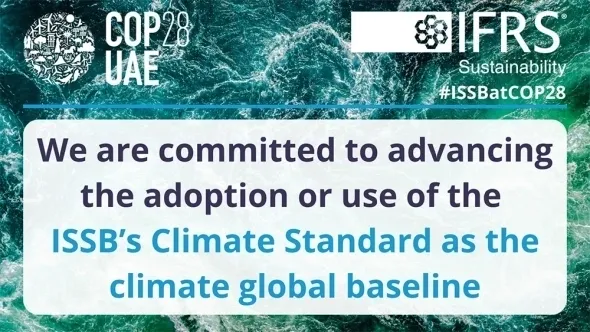
In the wake of COP28 in Dubai, a clarion call for action on climate risks and capital impact has resonated across the globe. The conference underscored the urgent need for consistent, comparable climate-related disclosures at an international level. This backdrop sets the stage for the transformative rollout of the IFRS S1 and S2 standards, a response aligning with the global momentum for enhanced ESG reporting.
IFRS statement on global adoption of ISSB’s SASB standards during COP 28
Finalized by the International Sustainability Standards Board (ISSB) on June 26, 2023, these standards represent a pivotal moment in the standardization of global corporate sustainability reporting. The ISSB, now part of the IFRS Foundation, has been instrumental in standardizing global financial reporting. Its involvement signals a new era of enhanced standardization and comparability in ESG disclosures. The IFRS S1 focuses on general sustainability reporting requirements, while IFRS S2 zeroes in on climate-related disclosures. Together, they aim to serve a broad spectrum of stakeholders, including global securities regulators, by emphasizing the financial materiality of businesses’ ESG information.
As the IFRS S1 and S2 standards gain global traction, Canadian businesses face a critical shift towards more transparent and consistent sustainability reporting. The rapid adoption of these standards in the US market indicates a significant impending impact on Canadian firms, highlighting the urgency for alignment with these evolving standards. Central to this alignment are the SASB standards, which provide a practical pathway for companies to meet the new global reporting norms.
The integration of SASB standards into the IFRS S1 and S2 represents a significant stride in the ESG reporting landscape, providing a practical pathway for companies to align with global reporting norms. Specifically, IFRS S1, which focuses on general sustainability reporting requirements, encourages companies to use SASB standards to identify and report on sustainability-related risks and opportunities. Similarly, IFRS S2, dedicated to climate-related disclosures, aligns with SASB’s approach to reporting on climate risks in different industries. Hence compliance with the IFRS S1 and S2 would mean the use of SASB standards in ESG disclosure.
SASB standards provide detailed guidance for businesses to disclose financially material sustainability information. Organized by industry, these standards feature “Disclosure Topics” that highlight areas of financial materiality. Each topic is paired with “Accounting Metrics” for quantitative or qualitative reporting, supplemented by “Activity Metrics” for added context.
Consider a beverage company reporting its annual water withdrawal as an “Accounting Metric” – say, 10 million gallons. To contextualize this, the company also reports an “Activity Metric”: three of its ten facilities are in water-stressed regions. This combination of metrics allows stakeholders to understand the implications of the company’s water usage more comprehensively.
Investors use these metrics to assess a company’s management of risks and opportunities related to each Disclosure Topic. Efficient water management, especially in water-stressed areas, can be a positive indicator of sustainable practices, influencing investment decisions.
So, this is how SASB standards are like having a custom playbook for sustainability reporting, tailored just for your industry. But here’s the million-dollar question: How do you put this playbook into action?
The process involves several key steps:
I) Aligning on the “Why”
2) Understanding Your Reporting Environment
3) Creating Organizational Buy-In
4) Determining Your Audience and their needs
5) Establish Data Needs and Perform a Gap Analysis
6) Ensure Reliable Information
7. Handling Omissions, Additions, and Modifications:
By following the above steps, companies can effectively integrate SASB standards into their reporting, enhancing the credibility and integration of IFRS S1 and S2 standards into their sustainability disclosures.
At YellowYellow, we’re not just about transforming ESG reporting; we turn it into a dynamic asset that propels your business forward. Fed up with one-size-fits-all solutions and hefty price tags? Our team, featuring three (3) FSA SASB-trained associates, is dedicated to crafting a bespoke journey tailored to your unique operational needs. We’re here to elevate your sustainability narrative, ensuring it resonates with your values and vision. Let’s collaborate to elevate your sustainability narrative and drive meaningful change. Reach out to hello@yellowyellow.ca to get started!


Kaitlyn D’Lima holds both a Bachelor of Business Administration and a Master of Science and Sustainability Management degree from the University of Toronto. She is also trained in greenhouse gas (GHG) accounting.
She brings extensive experience in sustainability and business transformational projects. She is known for her ability to execute projects of any size with both urgency and accuracy. Kaitlyn has a natural talent for improving stakeholder engagement. She’s a real trailblazer when it comes to benchmarking and research.
Kaitlyn is a runner who participates in outdoor adventure races.

Arun B Pazhayannur holds a degree in mechanical engineering and is a Chartered Accountant. He also has an MBA from the Ivey Business School at the University of Western Ontario. Along with his academic achievements, he has a thorough knowledge of Environmental, Social and Governance (ESG) principles, which he incorporates into his consulting work.
Arun is well-known for his leadership abilities as well as his strong skills in data analysis, financial modeling, and operations management. He has been recognized for his ability to identify practical solutions and deliver value to clients ranging from banks to payment companies to software providers. Arun is also a past President of Toastmasters Club.
In his free time, Arun enjoys scuba diving.In his spare time, Arun likes to scuba dive.

Gregory Donovan is a Chartered Accountant. He is a Fundamentals of Sustainable Accounting (FSA) Credential Holder. He obtained an Honours in Business Adminstrations (HBA) from the Ivey Business School (Western University) and a Master or Laws (LLM) from the London School of Economics. Gregory is the CEO of Avondale Private Capital, a sustainable finance firm focused on energy transition finance and carbon markets. He has presented on these topics at conferences in Canada, the US and UK.
Greg participates in the occasional triathlon and loves to go skiing and sailing with his two young children.

Margaux Loptson holds a Bachelor of Arts (Psychology) and a Bachelor of Arts (Criminology) from Pennsylvania State University. In addition, she holds several research certifications, including Ethical Conduct for Research Involving Humans.
She has been an essential player in AI-powered teaching and learning projects as a User Experience (UX) lead. Margaux is known for applying her design thinking, problem-solving and analytical skills to make a positive impact. She is a native French speaker.
Margaux is a fitness enthusiast who can be found hiking around Central Park in NYC.

Ritika Jain holds a Masters in Environmental Sciences, Policy and Management from Lund University (Sweden) and a Bachelor of Technology from Indraprastha University (India). As a lifelong learner, she is pursuing a Graduate Diploma in Corporate Social Responsibility and Sustainability at the University of Toronto.
Ritika is a recycling and responsible supply chain specialist. Through her work, she collaborates with organizations to implement circular economy focused policies to ensure compliance with regulations.
Her proficiency in data analytics and with the Global Reporting Initiative (GRI) enable her to manage complex sustainability data. Ritika also volunteers with the UN Sustainable Development Solutions Network, engaging with youth to drive positive change.
Ritika is a native Hindi speaker. She is a certified hiking leader who enjoys travelling.

Jonathan Spence holds an Honours Bachelor of Integrated Sciences (Earth and Environmental Sciences) from McMaster University and has his certification in Geographic Information Sciences from the ESRI Canada Center of Excellence at McMaster University. Jonathan worked as a research analyst in the environment and sustainability group for a TSX listed company.
He is pursuing his Ph.D. in Earth and Atmospheric Sciences at the University of Alberta, where he is researching the development of carbon capture techniques and their applications to the mining industry. Jonathan is focused on helping companies to minimize their carbon footprint while supporting their economic growth.
Jonathan is an avid water polo player and coach. He plays for the local National Championship League team.

Gurnoor Gandhi holds an MBA from Ivey Business School (Western University) and a postgraduate diploma in Maritime Energy Management (Sweden). Gurnoor brings experience with sustainability frameworks including TCFD, GRI, and CDP and is pursuing FSA credential (SASB).
Gurnoor has global leadership experience in the shipping industry managing assets worth millions of dollars on the high seas and has led diverse teams worked in Monaco, Singapore, and India. Most recently, he led organizational development and client partnerships at CARD, a non-profit focused on rural development and renewable energy.
Gurnoor brings a blend of technical and leadership skills. He applied his knowledge of greenhouse gas accounting and carbon capture to support clients with niche energy transition projects. He is known for putting his problem-solving, stakeholder management, and project management skills to work to help firms expedite their ESG Journey.
Gurnoor is a certified BMW adventure motorcyclist who finds off-road rides rejuvenating for body and spirit. He enjoys hiking with his family.

Lisa Annabel Ellis holds an Honours Bachelor of Science (Environmental Science) from the University of Toronto and an MBA from the Ivey Business School (Western University). She is a certified Project Manager Professional (PMP) with a Six Sigma Green Belt. Lisa is a Fundamentals of Sustainable Accounting (FSA) Level II Candidate. Applying her deep expertise in business and operational strategies, she has led award-winning transformational initiatives.
Drawing on her well-rounded science and finance expertise, she launched YellowYellow to help clients advance their sustainability practices. As an advocate of transparency and good governance, she partners with clients to understand their risks and opportunities to generate superior long-term value. Stakeholders across the value chain recognize the impact of this effort. She has been called upon to be a keynote speaker and lecturer.
Lisa is an advanced scuba diver who enjoys most water-related sports.